
Arcadigo guide
Play chess online against a computer: a Royal Chess practice plan
Practise chess online against a clearly labelled bot in Royal Chess. Learn how to use short games to test one opening idea and review mistakes.
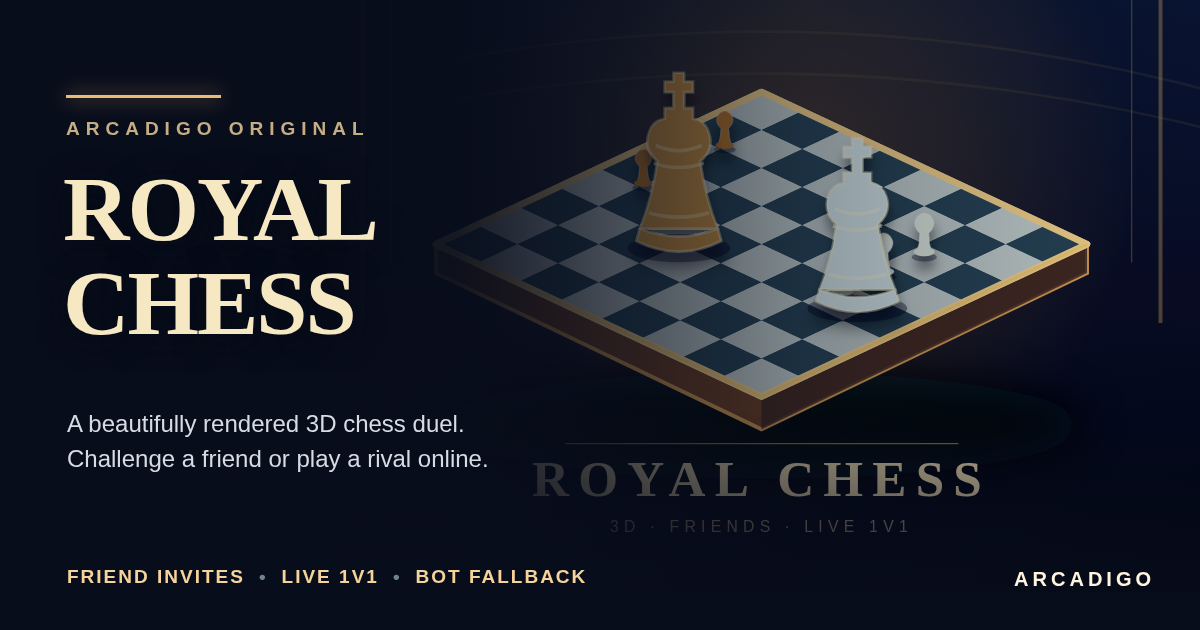
<p><strong>Play chess online against a computer</strong> when you want a quick practice game without waiting for a human opponent. Royal Chess runs in the browser and labels its bot option clearly. Public matchmaking looks for a human for eight seconds, then starts against a bot if nobody is available. Both sides use the same pieces and rules, and the server validates every move, check, checkmate, stalemate and draw. That makes a bot game useful for testing one idea at a time.</p> <h2>Pick a practice goal before you start</h2> <p>A short game can become more useful when you set one question in advance. Choose a goal such as developing both knights, castling before launching an attack or checking whether a pawn push leaves a square weak. Do not try to repair every part of your chess at once. A single goal gives you something concrete to review after the final position.</p> <p>Royal Chess offers a 1v1 board and can place a clearly labelled bot after the public queue has searched for a human. The game supports touch and keyboard input, so select the controls that are comfortable on your device. Before the first move, confirm that you are in the intended mode. A bot is useful for repeated practice, while a human game brings a different kind of pressure and unpredictability.</p> <h2>Use the opening to build a stable position</h2> <p>In the opening, develop pieces toward useful squares, contest the centre and avoid moving the same piece repeatedly without a reason. A central pawn move can create room for bishops and knights, but the exact opening depends on the opponent’s reply. Keep an eye on king safety and do not send the queen on an early trip unless you understand how it can be attacked.</p> <p>These are broad principles rather than a fixed sequence. A bot may respond differently from a human and can sometimes make moves that change the usual plan. Instead of memorising a long line, ask what the last move threatens and which of your pieces is not yet active. If the position becomes unfamiliar, slow down and look for checks, captures and direct threats for both sides.</p> <h2>Review the bot’s replies</h2> <p>After each opponent move, pause briefly. Ask what changed: did a piece become attacked, did a file open, or did a pawn advance create a weak square? This habit matters more than trying to predict every future move. The bot’s reply can reveal whether your plan left a simple tactical answer. If you are surprised, write down the move and investigate the position after the game rather than repeating it immediately.</p> <p>A computer opponent is a practice partner, not a coach that explains every mistake. A win does not prove that every move was strong, and a loss does not mean the whole opening failed. Review the first moment when you lost material or gave up a clear advantage. Find one alternative move and test that idea in another game. Repeating the same position with one change makes the lesson easier to see.</p> <h2>Use difficulty as a learning setting</h2> <p>Royal Chess includes bot difficulty levels. Choose a level that lets you practise the skill you are working on. If a stronger bot ends every game before you can test a plan, lower the difficulty and focus on development or safe king placement. If you rarely face a challenge, increase it and practise calculating a short sequence before you move.</p> <p>Keep the level steady for several games before judging progress. Changing difficulty after every win or loss makes the results harder to compare. A useful practice record can be as simple as the opening idea, the first mistake and one adjustment for next time. The goal is not a perfect win rate; it is to recognise more patterns and make fewer rushed decisions.</p> <h2>Think through tactics and king safety</h2> <p>Before committing to a capture, check what can capture back. Look for forks, pins, discovered attacks and undefended pieces. A move that wins a pawn may expose your king or allow a more valuable piece to be trapped. Take a moment to scan the opponent’s checks and captures before you choose an attacking move of your own.</p> <p>Do not assume the bot will overlook a threat because it played a strange move earlier. The current position determines what is possible. If the game reaches an endgame, bring your king toward the centre when it is safe and use your pieces together. Keep track of the remaining time and avoid spending the whole clock on one move when a simple safe choice is available.</p> <h2>Know what a bot game can and cannot teach</h2> <p>Bot practice is convenient for testing ideas and learning controls. It does not replace games against people, where opponents have different habits and time pressure changes the decision process. Royal Chess clearly identifies a bot when matchmaking uses one, so you know what kind of game you are playing. If you move to a rated tournament elsewhere, follow that service’s rules about outside engines and assistance.</p> <p>Use computer analysis only after the practice game and in a setting that permits it. Do not use an external engine to choose moves during a live human game if the platform or event rules prohibit it. The point of a practice match is to improve your own board vision. First write down what you thought during the game, then check a position if you need help understanding the mistake.</p> <h2>A simple ten-minute chess routine</h2> <p>Choose one opening goal, play a short game, then spend a few minutes reviewing the first major error. Note the opponent’s reply that changed your plan and one safer alternative. Start the next game with the same idea and see whether you notice the position earlier. A short repeatable routine is easier to fit between other activities than an unstructured session of rapid games.</p> <p>Open the <a href="https://arcadigo.com/games/royal-chess">Royal Chess game page</a> for current controls and mode details. If you want to play chess online against a computer, choose a labelled bot, focus on one decision and review the game afterward. That approach turns a quick browser match into deliberate practice instead of chasing wins without learning from the positions.</p>