
Arcadigo guide
Free brain games online: read the grid in Signal Hunt
Looking for free brain games online? Learn how Signal Hunt’s 8×8 grid and heat clues create a short deduction challenge in your browser.
A quick deduction round for players who like clues
People searching for free brain games online often want a puzzle they can open in a browser and understand without a long set-up. Arcadigo’s Signal Hunt offers a compact deduction challenge: a grid of cells, hidden rival beacons and heat clues that help you narrow down where to scan. The aim is not to memorise a long sequence; it is to use each clue to make the next choice more informed.
Treat “brain game” as a search category for casual puzzles, not a medical test. Signal Hunt can be an entertaining way to practise reading clues and planning a few steps ahead, but one round cannot diagnose or measure memory, intelligence or health. The game’s appeal is the clear feedback from each scan and the chance to adjust your next move.
How Signal Hunt’s grid works
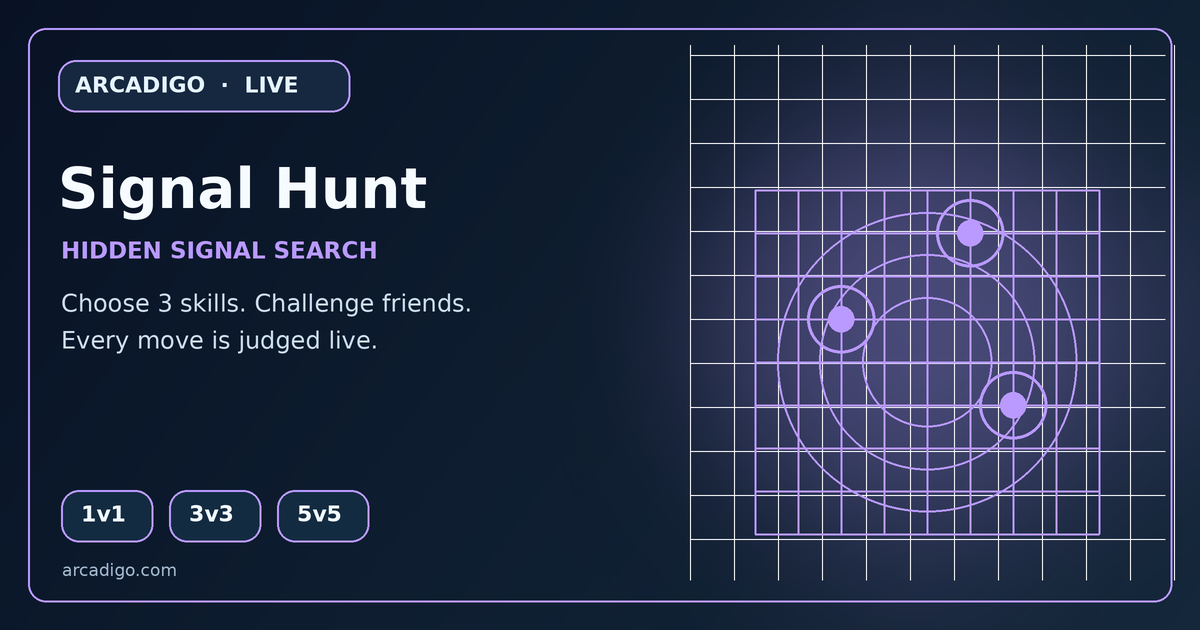
The Signal Hunt listing describes an 8×8 grid where players scan cells, follow heat clues and try to find hidden rival beacons. A scan gives information about the board. Your next task is to interpret that information rather than tapping every square at random. The grid gives the round boundaries; the clue gives a reason to consider some cells before others.
Before starting, read the controls on the local game page so you know how to select a cell and use any available action. The game is played in short real-time matches, so the board can change while you think. A clue should be read in the context of what you have already scanned, not as a promise that a target is sitting in one exact square.
Begin with a broad scan, then narrow your search
On an unfamiliar board, use the early scans to learn where the heat is stronger or weaker. Imagine dividing the 8×8 grid into a few broad areas rather than trying to remember all 64 cells individually. If one region gives a more promising clue, focus your next scan near it. If the next result points elsewhere, revise the map instead of continuing with the first guess.
This broad-to-narrow approach helps reduce unstructured clicking. Keep track of a few useful facts: where you scanned, what the clue suggested and which nearby cells you have not checked. You do not need an elaborate spreadsheet; a simple mental note of a warm zone, a cooler edge and an unexplored gap can be enough to plan the next move.
Use each clue to update your picture
A heat clue is evidence for a search decision, not a guarantee. After every scan, compare the result with the pattern you expected. Did the clue strengthen the region you were considering, or weaken it? Did your next move confirm the idea? This small check stops one early guess from becoming the only explanation you consider.
When two nearby areas seem equally plausible, choose a scan that helps separate them. A useful move is one that gives you information about the board, even if it does not immediately reveal a beacon. This is a general logic-puzzle habit: look for a question whose answer would change your next choice, rather than choosing a cell only because it is convenient.
Balance finding targets with protecting your own route
Signal Hunt is a multiplayer search game, so the other side’s progress matters too. When you have a clue that points toward a likely beacon, consider whether you can act before spending another move on a low-information scan. At the same time, avoid treating every nearby click as urgent; a calm sequence can be better than a string of guesses that leave you with no clear picture of the board.
Keep the current objective and clock visible. If an opponent is close to finding a target, a move that narrows your own search may be more useful than repeating a scan in an already explored area. The exact best choice depends on what the current round shows, so use the available clues and your remaining time rather than relying on a fixed opening pattern.
Avoid the common random-click loop
Randomly jumping between distant cells makes clues harder to compare. If one scan is in the top-left and the next is in the bottom-right, you may learn that both areas differ, but leave the middle unexplored and lose the thread of your search. A local follow-up around a promising clue is easier to interpret because each new result answers a more focused question.
Another common mistake is to assume that one strong clue proves the exact target cell. It may point toward an area or a direction rather than identify a square. Check the game’s on-screen explanation and treat the visible feedback as the rule source. If a result conflicts with your mental map, update the map instead of insisting that the game must fit your first theory.
A simple first-round routine
First, scan a cell that helps establish a broad area. Second, use the clue to choose a nearby follow-up. Third, compare the new result with the first and mark the part of the grid you have already explored. Fourth, narrow toward the most promising zone while keeping an eye on the opponent and the match clock. Repeat that cycle until you find a beacon or the round ends.
After the match, remember one decision that made the board clearer and one that did not. Perhaps a scan separated two candidate zones, or perhaps a distant jump made it difficult to interpret the next clue. Carry one small observation into the next round; the goal is to learn the game’s feedback, not to memorise a supposed winning sequence.
Browser setup and short sessions
Signal Hunt runs from Arcadigo’s local game catalogue. Open the game page to see the current controls, supported devices and mode details before starting. A modern browser and a steady connection help keep a live round readable. On a phone, check that the grid fits your screen and that you can tap the intended cell without covering nearby clues.
Free browser games can vary in pace and control style, so take a moment to orient yourself before a competitive round. If the board is moving quickly, focus on one clue and one next scan at a time. Leaving other tabs or overlays on top of the game can make it easier to miss a clue update, especially on a smaller screen.
Try a free online brain game in Signal Hunt
If you want a deduction puzzle rather than a word list or arithmetic grid, Signal Hunt gives you a different type of short challenge. Start with broad scans, track the clues and refine the search without assuming that one hint reveals the answer. Visit the Signal Hunt game page for the current rules and controls, and browse the full Arcadigo catalogue for other browser games.
Explore the free online arcade games hub or read the Arcadigo India English archive for more guides. Signal Hunt is entertainment: the puzzle can be enjoyable without making claims about a player’s health or ability.