
Arcadigo guide
Free co-op browser games: coordinate a Core Crew run
Learn the two-player repair and Seal loop, the 60-second timer and heat management in Arcadigo's Core Crew co-op browser game.
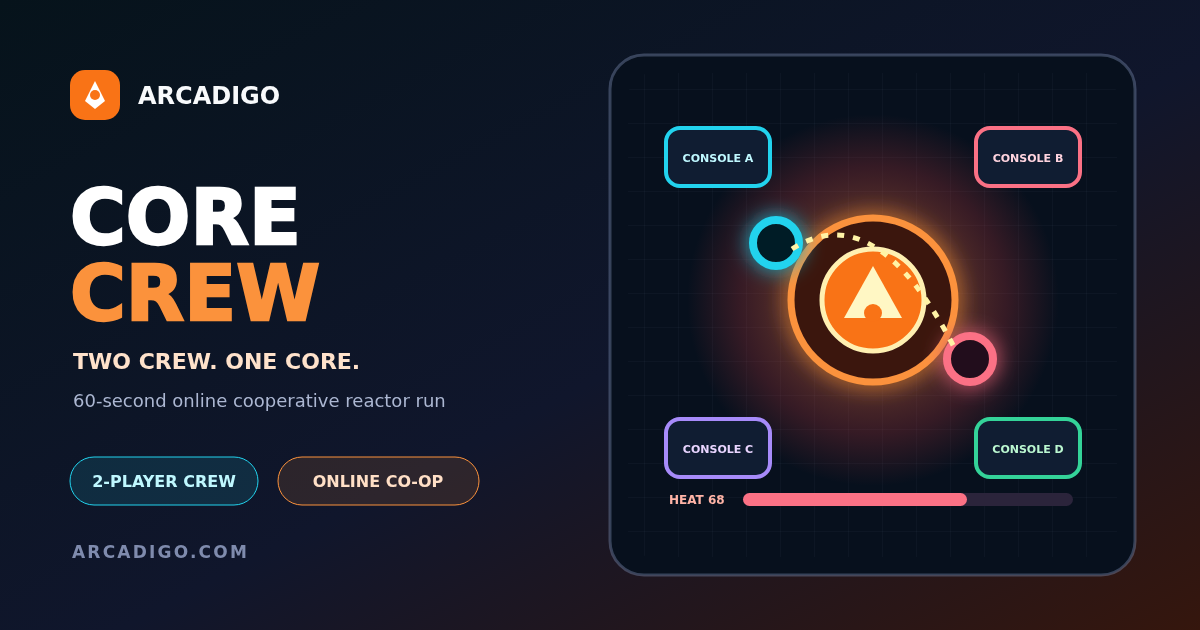
<p><strong>Free co-op browser games</strong> are a quick way to play together without installing a large game first. Core Crew is a two-player reactor rescue with one shared heat gauge and a 60-second round. The key is the linked action: one player repairs a fault until it is primed, then the other player must Seal it within 1.2 seconds. A successful pair clears the fault and lowers the team’s heat. Both players need to understand the timing; two people repairing separately will not complete the linked objective.</p> <h2>Understand the shared objective</h2> <p>Your crew must complete eight linked Seals before the 60-second timer ends and keep heat below 100. Unresolved faults push the shared gauge upward. A successful Seal clears one fault, lowers heat by eight and pauses further heat growth for three seconds. This means every completed sequence has two benefits: progress towards the survival target and a short period of relief from the rising heat. Watch both the fault state and the gauge rather than focusing on only one part of the interface.</p> <p>The game is cooperative rather than a race against the other player. Both seats share the same outcome, so communicating the next fault matters more than competing for a personal score. Decide who will Repair and who will Seal before moving to the reactor. Once a fault is primed, the partner has a small window to finish the action. If you are both standing too far away or focused on different faults, that window can pass before the team is ready.</p> <h2>Use the Repair and Seal sequence</h2> <p>Move near an active fault and hold Repair until the progress reaches 100. The fault then becomes primed for the second player. The partner must use Seal within 1.2 seconds. Learn the displayed indication for a primed fault and call it out as soon as it appears. If the partner is across the arena, plan the approach before the first player finishes repairing. Good timing begins with positioning, not just fast button presses.</p> <p>After a successful Seal, take a moment to confirm that the fault cleared, the heat dropped and the next target became active. Then move together or split tasks only if the game state makes that safe. Avoid both players holding Repair on the same fault unless the current instructions say it helps. The game’s linked mechanic requires two distinct crewmates for the finishing action, so the team should keep track of who is assigned to each step.</p> <h2>Manage heat and the 60-second timer</h2> <p>Heat is shared, and unresolved faults can push it towards meltdown. A single mistake may be recoverable, but repeated delays can consume the remaining margin. Check the gauge after every fault and prioritise the active repair rather than wandering across the map. A successful Seal pauses heat growth for three seconds, which gives the crew a brief reset. Use that moment to identify the next fault and agree on who will Repair and who will Seal.</p> <p>The 60-second limit rewards concise communication. Use short calls such as “repairing left” or “ready to seal” so your partner can react. If the timer is running low, do not split up without a reason. The repair progress and partner window are easier to complete when both players can reach the active fault quickly. If a run ends in meltdown, note whether the problem was late movement, missed timing or too many unresolved faults; then choose one adjustment for the next attempt.</p> <h2>Choose a useful matchmaking option</h2> <p>Core Crew offers a two-player experience. Instant Match looks for another crewmate and may fill the second seat with a clearly labelled AI partner if none is available. Human Only waits for a second person and does not add AI. Pick the option that matches how you want to play. If you choose Human Only, allow time for another player to join. If an AI is present, remember that it follows the same Repair and 1.2-second Seal rule.</p> <p>If you are playing with a friend, agree on the roles before starting and use a voice call or quick chat if available. One player can take responsibility for Repair while the other watches the fault state and prepares to Seal. You can switch roles between faults so both people learn the controls. Do not assume that two players who understand the controls will automatically coordinate; the order and timing of actions are the core challenge.</p> <h2>Controls on desktop and mobile</h2> <p>On keyboard, movement uses WASD or the arrow keys; Space is Repair and E is Seal. Touch controls provide a movement joystick and separate Repair and Seal buttons. Review the game page for the current layout before playing, especially on a smaller phone screen. Keep the fault and heat gauge visible while moving. If the controls feel cramped, change the device orientation or adjust the browser zoom only if the game remains fully visible.</p> <p>Stable input and connection help both players complete the short partner window. A delayed command can be mistaken for a missed call, so confirm the active fault and action state before repeating a button press. If one player disconnects or a control fails, read the on-screen message and use the available matchmaking or restart options. Avoid sharing private account details in a public lobby; the game needs coordinated actions, not personal information.</p> <h2>Improve one part of the run at a time</h2> <p>After each attempt, ask which step failed: reaching the fault, finishing Repair, noticing the primed state, or using Seal on time. If the crew repeatedly misses the 1.2-second window, move closer before Repair completes. If heat rises too quickly, shorten the gap between completed faults and avoid unnecessary movement. If the team reaches eight Seals but runs out of time, focus on clearer calls rather than faster button presses alone.</p> <p>Reviewing one failure at a time makes the next run easier to coordinate. Keep a simple plan: identify a fault, send one player to Repair, prepare the partner, Seal within the window, confirm heat and progress, then move to the next target. Do not change every role and route after a single mistake. The same sequence becomes more reliable once both players know the cues.</p> <h2>Start a crew run</h2> <p>Open the <a href="https://arcadigo.com/games/core-crew">Core Crew game page</a> to see the current controls and start options. Remember the team target: eight linked Seals, under 100 heat, before the 60-second horn. Repair to 100, let the partner complete the Seal within 1.2 seconds and use the short heat pause to plan the next fault. Free co-op browser games are easy to open, but Core Crew rewards the pair that communicates and acts as one unit.</p>