
Arcadigo guide
Free online puzzle games: a quick-start guide to Circuit Bloom
Looking for free online puzzle games? Learn Circuit Bloom’s pulse-routing idea, quick planning tips and how to start a 1v1 or 2v2 browser match.
A free puzzle game with a quick match loop
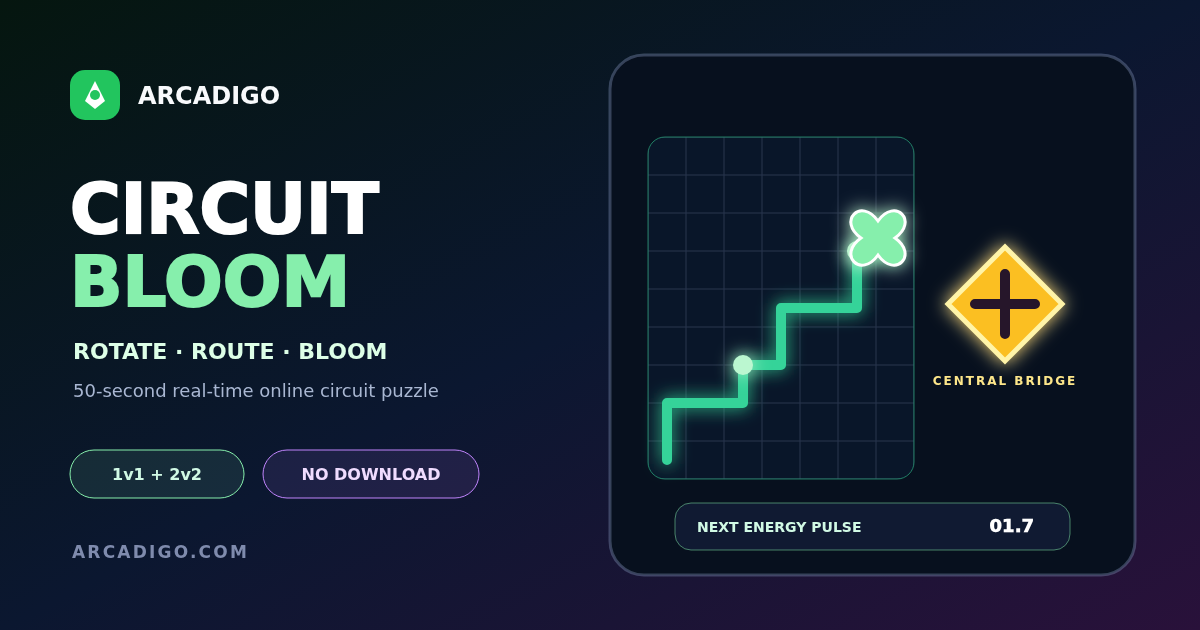
If you are browsing free online puzzle games in Australia, the right pick depends on whether you want a quiet solo puzzle or a short contest with another person. Circuit Bloom is Arcadigo’s real-time circuit-routing puzzle. Two mirrored boards carry green and violet energy pulses toward glowing blooms, with a central Bridge linking the action. A match runs for 50 seconds and supports 1v1 or 2v2 play. The compact round makes it easy to try between other plans, while the timer means you will want to scan the board before making a move.
What you do in Circuit Bloom
The basic idea is to rotate and route circuit paths so the timed pulse can travel across the board and reach a bloom. Each side has its own colour and mirrored layout; the Bridge is the shared point where the two routes meet. That means you are solving a logic problem while paying attention to what the other side is doing. A move that looks tidy on one half of the grid may not be enough if the pulse misses the bridge or arrives after the useful window. Treat the board as a connected route, not a collection of isolated tiles.
Take a quick look before acting
When a round begins, use a moment to trace the likely path from the pulse toward the bloom. Find any obvious turns, gaps and the Bridge first. A quick mental route can stop you from rotating a tile just because it is nearest to the starting point. In a 50-second game, you do not have time to inspect every possible arrangement, so start with the route that could connect the most useful sections. If a board changes after a pulse passes, scan again rather than assuming the path is unchanged.
Think in short sections, not one long maze
Break a route into manageable pieces: the first run, the turn toward the Bridge, and the final approach to the bloom. Check whether each segment can connect to the next before spending time on a detailed plan. The two mirrored boards can make patterns easier to compare, but do not assume both sides need the same sequence of rotations. One side may have a straightforward path while the other requires a different turn. Small checks reduce avoidable backtracking and give you a clearer idea of where the bottleneck sits.
Use the Bridge as a timing point
The central Bridge is more than a visual divider; it is the route between the mirrored circuits. Keep an eye on the next energy pulse and consider when your connection will be ready. A path that is complete too early may need a small adjustment before the pulse arrives, while a route finished too late can miss the scoring opportunity. Since the game is real time, compare the visible pulse timing with the work left on your board. This is a suggestion for prioritising attention, not a promise that one particular route will score.
Play with a mate in 1v1 or 2v2
For a direct duel, 1v1 lets you focus on your own route while watching the other colour. If you choose 2v2, communicate briefly with your partner. One person can keep track of the next pulse while the other watches the Bridge and the opposing path. Long instructions can be hard to follow in a timed round, so use simple call-outs such as “left turn”, “bridge clear” or “pulse next”. If you are playing with a mate on a call, agree on what those phrases mean before the timer starts.
Make the controls work for you
Circuit Bloom is designed to run in a browser, so you can open the game page without installing a separate desktop game. A larger screen may make the mirrored layout easier to inspect, while a phone gives you a convenient way to play on the go. Before the match, check that the page has finished loading and that the board responds to your input. If a touch or click does not select a tile, pause and try again rather than repeating several moves blindly. A stable connection helps a real-time game feel more predictable for both sides.
Choose a puzzle that fits your break
Free online puzzle games cover different moods. A daily word or number grid is a slower solo challenge; a timed circuit match asks you to spot a path and act quickly; a team puzzle adds communication. Circuit Bloom fits the last two styles because it uses a short real-time format and has both head-to-head and team modes. If you want to unwind, you may prefer a game without a countdown. If you enjoy a quick brain-teaser with a mate, a 50-second round gives you a clear start and finish without turning the whole evening into a long session.
Try one round, then review a single decision
After the match, pick one moment to review: Did you trace the route before rotating, notice the next pulse, or lose time at the Bridge? Changing one habit at a time is more useful than trying to memorise a perfect sequence. Each board can ask for a different route, and the other player’s actions make a round feel different. If you are new, use your first game to learn what the pulse looks like and how the two halves connect. Then start another round with one small plan in mind.
Start playing
Open Circuit Bloom to see the board and choose a match format. Trace the route, keep the Bridge and pulse timing in view, and use quick call-outs if you are playing 2v2. For more free browser options, visit the Arcadigo games library; for more guides, browse the Arcadigo blog in Australian English.